
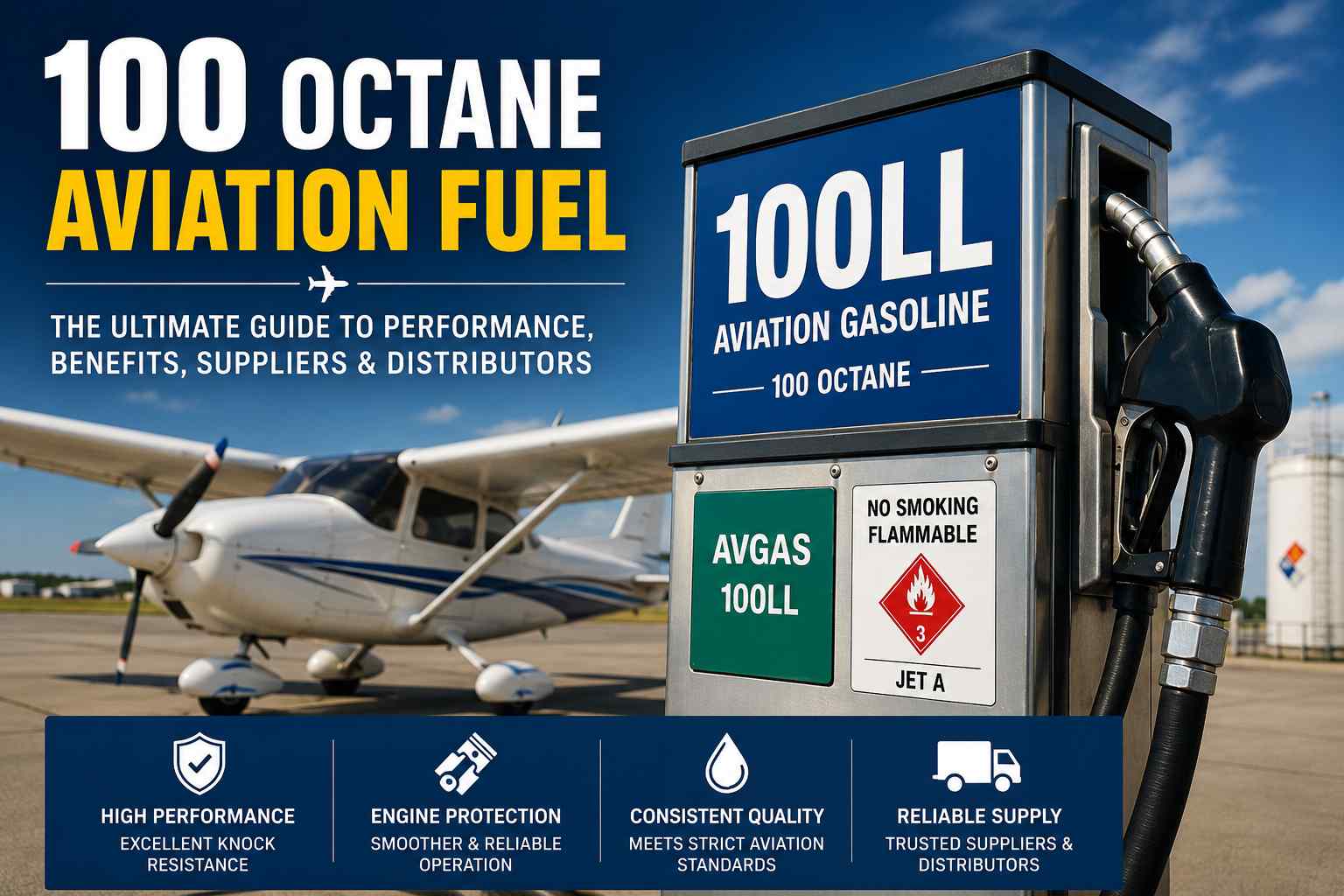
100 octane aviation fuel is a high-performance aviation gasoline (Avgas) designed primarily for piston-engine aircraft. Commonly available as 100LL (Low Lead), it provides excellent detonation resistance, reliable engine performance, and dependable operation under demanding flight conditions. Pilots, aircraft operators, flight schools, and aviation businesses rely on trusted 100LL aviation fuel distributors and suppliers to ensure consistent fuel quality, regulatory compliance, and uninterrupted operations.
Understanding 100 Octane Aviation Fuel
Whether you’re a private pilot, aircraft owner, flight school operator, or aviation fuel procurement manager, selecting the right aviation gasoline is essential for aircraft performance and safety. Among the most widely used aviation gasolines worldwide, 100 octane aviation fuel continues to set the benchmark for piston-powered aircraft because of its superior anti-knock properties and dependable engine protection.
Unlike automotive gasoline, aviation gasoline is specially formulated to meet strict aviation industry standards. Every batch must deliver consistent combustion characteristics, maintain engine reliability, and support safe flight operations in varying weather and altitude conditions.
As aviation continues to evolve, demand remains strong for dependable suppliers offering 100LL fuel for sale, timely delivery, and quality assurance across airports, FBOs, and commercial aviation facilities.
What Is 100 Octane Aviation Fuel?
100 octane aviation fuel—commonly marketed as 100LL aviation gasoline—is a specialized aviation gasoline developed specifically for spark-ignition piston aircraft engines.
The “100” represents its high octane performance, enabling aircraft engines to operate safely at high compression ratios without experiencing harmful detonation or pre-ignition.
Although commonly called 100 octane aviation fuel, today’s industry-standard product is 100LL (Low Lead), which contains a reduced amount of tetraethyl lead compared with older aviation gasoline grades while still providing the octane performance required by many certified aircraft engines.
This fuel is trusted by:
- Private aircraft owners
- Flight schools
- Charter operators
- Flying clubs
- Aircraft maintenance facilities
- Agricultural aviation operators
- Government aviation fleets
Why the Octane Rating Matters
One of the most important characteristics of aviation gasoline is its octane rating 100LL fuel provides.
The octane rating measures a fuel’s ability to resist engine knocking or uncontrolled combustion during ignition.
Higher octane ratings provide several important advantages:
- Better engine protection
- Stable combustion
- Improved climb performance
- Reduced risk of detonation
- Increased reliability under heavy engine loads
- Better performance during hot weather operations
- Consistent power output at higher altitudes
Because aircraft engines often operate continuously at high power settings, maintaining the proper octane rating is essential for safety and long-term engine health.
Key Characteristics of 100LL Aviation Fuel
Modern 100 octane aviation fuel is engineered to deliver predictable performance throughout every phase of flight.
Its major characteristics include:
| Feature | Benefit |
|---|---|
| High Octane Rating | Prevents detonation |
| Excellent Vapor Stability | Reliable engine starts |
| Low Lead Formula | Lower lead content than older Avgas grades |
| Consistent Combustion | Smooth engine operation |
| Strict Quality Control | Reliable fuel performance |
| Long-Term Storage Stability | Suitable for aviation inventory management |
These characteristics explain why 100LL aviation gasoline supplier networks play such an important role in supporting airports and aviation businesses around the world.
Which Aircraft Use 100 Octane Aviation Fuel?
Many piston-powered aircraft continue to rely on 100 octane aviation fuel for safe and efficient operation.
Typical applications include:
Flight Training Aircraft
Training fleets perform hundreds of takeoffs and landings every week. Consistent fuel quality helps reduce engine wear while providing reliable performance during repeated operations.
Private Aircraft
Many privately owned single-engine and twin-engine aircraft are certified to operate on 100LL aviation gasoline because of its dependable combustion characteristics.
Agricultural Aircraft
Crop dusters often operate under demanding environmental conditions. High-performance aviation gasoline helps support engine reliability during extended operating hours.
Air Ambulance and Special Mission Aircraft
Some specialized piston-engine aircraft used for emergency response, surveying, and utility operations also depend on high-octane aviation gasoline.
How Is Aviation Fuel Different from Automotive Gasoline?
Although both are petroleum-based fuels, aviation gasoline is manufactured under significantly stricter quality requirements.
| Automotive Gasoline | 100 Octane Aviation Fuel |
|---|---|
| Designed for cars | Designed for aircraft |
| Variable seasonal blends | Strict aviation specifications |
| Lower quality tolerance | Tight quality control |
| Shorter storage life | Greater storage stability |
| Road transportation | Aviation-certified distribution |
This difference is why aircraft operators should purchase fuel only from experienced 100LL aviation fuel distributors that follow established quality assurance procedures.
The Growing Importance of Reliable Aviation Fuel Suppliers
Fuel quality directly affects aircraft safety, operational efficiency, and maintenance costs. As a result, aviation organizations increasingly work with experienced suppliers that can provide dependable fuel logistics and consistent product availability.
When evaluating a 100LL octane aviation gasoline supplier, operators typically consider:
- Product quality
- Industry experience
- Reliable fuel sourcing
- Timely delivery
- Regulatory compliance
- Customer support
- Inventory management
- Nationwide or international supply capabilities
Working with an established supplier helps reduce operational disruptions while ensuring fuel meets the specifications required for piston-engine aircraft.
Why Quality Distribution Matters
The aviation fuel supply chain extends far beyond refining. Proper storage, transportation, handling, and delivery all play a role in preserving fuel integrity.
Experienced aviation gasoline 100LL distributors implement quality control measures throughout the distribution process to help minimize contamination risks and maintain consistent fuel performance from storage facility to aircraft.
For airports, FBOs, flight schools, and commercial operators, partnering with a trusted distributor helps ensure reliable fuel availability while supporting safe day-to-day operations.
Choosing the Right Aviation Fuel Partner
When sourcing 100LL fuel for sale, price is only one consideration. Equally important are product consistency, supply reliability, logistics expertise, and responsive customer service.
A trusted aviation fuel provider should be able to support diverse operational requirements, whether supplying a local airport, a regional flight school, or a large commercial aviation network.
As an experienced provider in the aviation fuel industry, Sergeant Oil & Gas helps connect aviation businesses with dependable fuel supply solutions, emphasizing quality, reliability, and efficient distribution to meet the evolving needs of the aviation sector.
Benefits of 100 Octane Aviation Fuel
Selecting the correct aviation gasoline directly impacts aircraft performance, engine longevity, maintenance costs, and operational safety. 100 octane aviation fuel, commonly available as 100LL (Low Lead), has remained the preferred choice for many piston-engine aircraft because it delivers reliable performance in a wide range of operating conditions.
Whether an aircraft is used for private flying, pilot training, aerial surveying, agricultural work, or charter operations, high-quality aviation gasoline helps ensure consistent engine operation from takeoff through landing.
Superior Engine Protection
Aircraft engines operate under continuous high power settings, making fuel quality critical. The high octane rating 100LL fuel offers helps prevent detonation and pre-ignition, reducing stress on engine components and supporting long-term reliability.
Benefits include:
- Reduced engine knocking
- Smooth combustion
- Improved power output
- Better climb performance
- Lower risk of engine damage
- Consistent operation during extended flights
Using aviation gasoline that meets recognized industry standards also helps maintain engine performance between scheduled maintenance intervals.
Consistent Performance Across Flight Conditions
Unlike automotive fuels, aviation gasoline is designed to perform consistently under varying temperatures, pressures, and altitudes.
High-quality 100 octane aviation fuel provides dependable performance during:
- Cold weather starts
- High-altitude operations
- Hot summer conditions
- Long cross-country flights
- Frequent takeoffs and landings
- Continuous high-power engine operation
This consistency is one reason flight schools and commercial operators rely on experienced suppliers when sourcing aviation fuel.
Why Fuel Quality Matters
Fuel contamination can lead to costly maintenance issues and operational delays. Working with a trusted 100LL aviation fuel distributor helps ensure proper handling, storage, and transportation practices that preserve fuel quality throughout the supply chain.
Reliable distributors typically focus on:
- Quality assurance procedures
- Proper storage practices
- Timely fuel delivery
- Inventory management
- Product traceability
- Compliance with applicable fuel specifications
Choosing a dependable distribution partner helps reduce operational risks while supporting safe aircraft performance.
100LL Aviation Fuel vs. Jet A Fuel
One of the most common questions from aircraft owners is whether 100 octane aviation fuel and Jet A fuel can be used interchangeably.
The answer is no.
Although both are aviation fuels, they are formulated for different engine types.
| Feature | 100LL Aviation Fuel | Jet A Fuel |
|---|---|---|
| Fuel Type | Aviation Gasoline (Avgas) | Kerosene-Based Turbine Fuel |
| Engine Type | Piston Engines | Turbine and Jet Engines |
| Ignition | Spark Ignition | Compression Ignition |
| Octane/Cetane | High Octane | Cetane Characteristics |
| Typical Users | General Aviation Aircraft | Commercial Jets, Turboprops, Helicopters |
Using the wrong fuel can result in serious engine damage, making proper fuel selection essential for safe operations.
Understanding 100LL Aviation Gasoline
The “LL” in 100LL stands for Low Lead. Although it contains less tetraethyl lead than older aviation gasoline grades, it still provides the octane performance required by many certified piston aircraft engines.
Many operators continue using 100LL because it offers:
- Proven reliability
- Excellent detonation resistance
- Stable combustion
- Wide aircraft compatibility
- Established global availability
Today, airports worldwide continue to stock 100LL due to its extensive use across the general aviation industry.
Aviation Fuel Standards and Quality Control
Every gallon of aviation gasoline must meet strict quality requirements before reaching an aircraft.
Throughout production and distribution, fuel undergoes multiple quality checks designed to verify:
- Fuel purity
- Correct chemical composition
- Water contamination prevention
- Storage integrity
- Transportation quality
- Product consistency
Professional aviation gasoline 100LL distributors follow established handling procedures that help maintain these standards throughout the distribution process.
Safe Storage and Fuel Handling
Proper storage plays an important role in maintaining aviation fuel quality.
Best practices include:
- Using approved storage tanks
- Regular tank inspections
- Water drainage procedures
- Fuel filtration
- Routine quality testing
- Clean transfer equipment
- Environmental protection measures
Operators purchasing 100LL fuel for sale should work with suppliers that emphasize proper storage and handling throughout the supply chain.
How to Choose the Right Aviation Fuel Supplier
Fuel quality depends not only on production but also on the expertise of the supplier.
When evaluating a 100LL aviation gasoline supplier, consider factors such as:
Industry Experience
Experienced suppliers understand aviation fuel requirements and support customers with reliable service.
Supply Reliability
Consistent fuel availability helps reduce operational disruptions for airports, flight schools, and commercial operators.
Quality Assurance
Choose suppliers with documented quality control procedures covering storage, transportation, and delivery.
Logistics Capabilities
A dependable supplier should provide efficient delivery schedules and flexible fuel management solutions.
Customer Support
Responsive communication and knowledgeable service teams can help address operational needs quickly.
Finding a Trusted 100LL Octane Aviation Gasoline Supplier
As aviation operations continue to expand globally, businesses increasingly seek dependable fuel partners capable of meeting demanding operational requirements.
A reliable 100LL octane aviation gasoline supplier should offer:
- Consistent product availability
- Competitive sourcing options
- Quality-focused distribution
- Flexible logistics
- Industry knowledge
- Efficient customer support
- Scalable supply solutions
Working with an experienced supplier helps aviation businesses maintain operational continuity while reducing supply chain challenges.
Why Distribution Networks Matter
Large distribution networks improve fuel availability and support efficient operations across multiple locations.
Established aviation gasoline 100LL distributors help airports, FBOs, maintenance facilities, and aviation companies maintain dependable fuel inventories through coordinated logistics and reliable delivery services.
Strong distribution capabilities also help minimize delays, particularly during periods of increased aviation activity.
Sergeant Oil & Gas: Supporting Reliable Aviation Fuel Supply
For aviation businesses seeking dependable fuel solutions, Sergeant Oil & Gas provides access to aviation fuel supply services designed to support operational efficiency and reliability.
Whether customers require guidance on sourcing 100 octane aviation fuel, identifying a trusted 100LL aviation fuel distributor, or exploring fuel procurement options, the company focuses on connecting clients with quality-driven solutions backed by industry expertise.
Its commitment to dependable supply, efficient logistics, and responsive customer service makes Sergeant Oil & Gas a valuable resource for airports, aviation operators, flight schools, and fuel buyers looking for consistent fuel availability.
Where to Find 100LL Fuel for Sale
As demand for piston-engine aircraft remains strong, operators continue searching for dependable sources of 100LL fuel for sale. Whether purchasing fuel for a flight school, private fleet, agricultural aircraft, or airport operation, selecting the right supplier is just as important as choosing the correct fuel grade.
A reliable fuel partner helps ensure timely deliveries, consistent product quality, and a dependable supply chain. Beyond pricing, buyers should evaluate a supplier’s logistics capabilities, product availability, customer support, and commitment to quality assurance.
Choosing the Right 100LL Aviation Fuel Distributor
Selecting a trusted 100LL aviation fuel distributor is essential for maintaining safe and efficient aircraft operations. Distributors play a vital role in preserving fuel quality from storage terminals to airport facilities by following strict handling and transportation procedures.
When comparing distributors, consider the following factors:
- Experience serving the aviation industry
- Reliable fuel sourcing and availability
- Efficient logistics and delivery networks
- Product quality control measures
- Responsive customer support
- Flexible supply solutions for different operational needs
A distributor with a strong industry network can help reduce supply disruptions while supporting consistent aviation operations.
Working with a 100LL Aviation Gasoline Supplier
An experienced 100LL aviation gasoline supplier provides more than fuel—they help customers manage procurement efficiently while maintaining product consistency.
A dependable supplier typically offers:
- Reliable fuel procurement
- Flexible delivery options
- Support for airports and FBOs
- Assistance with bulk fuel requirements
- Consistent communication throughout the supply process
Working with an established supplier can improve operational planning and reduce downtime caused by fuel shortages.
The Role of a 100LL Octane Aviation Gasoline Supplier
Many aviation businesses require specialized support when sourcing aviation gasoline for piston-engine aircraft. A professional 100LL octane aviation gasoline supplier understands the importance of product consistency, timely delivery, and dependable logistics.
Whether serving flight schools, maintenance organizations, charter operators, or private aircraft owners, experienced suppliers focus on maintaining a reliable fuel supply while helping customers meet their operational requirements.
Why Aviation Gasoline 100LL Distributors Matter
The aviation industry depends on efficient fuel distribution networks to keep aircraft operating safely and on schedule. Professional aviation gasoline 100LL distributors coordinate transportation, storage, and delivery to help ensure fuel reaches airports and aviation facilities in optimal condition.
Effective distribution networks provide several advantages:
- Improved fuel availability
- Reduced delivery delays
- Consistent fuel quality
- Better inventory management
- Scalable supply solutions
- Enhanced operational reliability
For airports and aviation operators, choosing the right distribution partner contributes to smoother day-to-day operations and long-term planning.
Industry Trends Driving Demand for 100 Octane Aviation Fuel
Although the aviation industry continues exploring alternative fuels and lower-emission technologies, 100 octane aviation fuel remains the standard choice for many certified piston-engine aircraft.
Several factors continue to support demand:
Growth in Flight Training
The increasing need for new pilots has expanded flight training operations worldwide, leading to sustained demand for aviation gasoline.
Private Aviation Expansion
More individuals and businesses are investing in private aircraft, increasing fuel consumption across general aviation.
Agricultural Aviation
Agricultural aircraft continue to play an important role in crop protection and precision farming, requiring dependable aviation gasoline.
Fleet Modernization
Aircraft owners continue investing in maintenance and upgrades, making fuel quality a key consideration for engine reliability.
Why Sergeant Oil & Gas Is a Valuable Industry Resource
Finding a dependable aviation fuel partner is an important part of successful flight operations. Sergeant Oil & Gas supports aviation businesses by providing information and fuel supply solutions for customers seeking dependable aviation fuel procurement.
Whether you’re looking for guidance on 100 octane aviation fuel, evaluating a 100LL aviation fuel distributor, or exploring options for 100LL fuel for sale, Sergeant Oil & Gas serves as a valuable resource for aviation professionals seeking reliable fuel solutions.
By focusing on customer service, efficient logistics, and industry knowledge, the company helps connect aviation businesses with fuel supply options that support operational continuity.
Key Takeaways
- 100 octane aviation fuel is the preferred aviation gasoline for many piston-engine aircraft.
- The octane rating 100LL fuel provides excellent resistance to engine knock and supports reliable performance.
- Choosing a trusted 100LL aviation fuel distributor helps maintain fuel quality and supply consistency.
- A dependable 100LL aviation gasoline supplier can improve procurement efficiency and reduce operational disruptions.
- Experienced aviation gasoline 100LL distributors support airports, FBOs, flight schools, and commercial aviation operations through reliable logistics.
- When evaluating 100LL fuel for sale, buyers should consider product quality, availability, and supplier expertise in addition to price.
Conclusion
As the general aviation sector continues to evolve, 100 octane aviation fuel remains a critical resource for piston-engine aircraft around the world. Its high-performance characteristics, dependable combustion, and established industry acceptance make it an essential fuel for flight schools, private pilots, agricultural operators, and aviation businesses.
Choosing the right fuel supplier is equally important. Whether you’re searching for 100LL fuel for sale, a trusted 100LL aviation fuel distributor, or an experienced 100LL aviation gasoline supplier, working with a knowledgeable partner helps ensure product quality, reliable delivery, and operational efficiency.
For organizations seeking dependable aviation fuel solutions, Sergeant Oil & Gas offers industry expertise and fuel procurement support designed to help aviation professionals source quality aviation fuel with confidence.
Frequently Asked Questions
Q1: What is 100 octane aviation fuel?
100 octane aviation fuel is a high-performance aviation gasoline designed for piston-engine aircraft. Most operators use 100LL (Low Lead) aviation gasoline because it provides excellent detonation resistance, reliable engine performance, and compliance with industry fuel specifications.
Q2: Is 100LL the same as 100 octane aviation fuel?
Yes. In most aviation applications, 100LL aviation gasoline is the commonly available form of 100 octane aviation fuel. While it contains a reduced amount of lead compared to older aviation gasoline grades, it still delivers the octane performance required for many certified piston-engine aircraft.
Q3: What does the octane rating of 100LL fuel mean?
The octane rating 100LL fuel refers to the fuel’s ability to resist engine knock or detonation during combustion. A higher octane rating helps protect aircraft engines operating under high power settings and demanding flight conditions.
Q4: Which aircraft use 100 octane aviation fuel?
Many general aviation aircraft equipped with spark-ignition piston engines use 100 octane aviation fuel. These include training aircraft, private airplanes, agricultural aircraft, aerial survey aircraft, and some charter fleets.
Q5: How do I choose a reliable 100LL aviation fuel distributor?
A reputable 100LL aviation fuel distributor should offer:
Consistent fuel quality
Reliable supply
Efficient logistics
Industry experience
Responsive customer service
Compliance with aviation fuel handling standards
Q6: What should I look for in a 100LL aviation gasoline supplier?
When selecting a 100LL aviation gasoline supplier, consider:
Product availability
Fuel quality assurance
Distribution network
Delivery capabilities
Customer support
Industry reputation
Working with an experienced supplier helps maintain operational efficiency and fuel reliability.
Q7: Where can I find 100LL fuel for sale?
Many airports, Fixed Base Operators (FBOs), and specialized aviation fuel providers offer 100LL fuel for sale. Choosing an established supplier helps ensure product quality, dependable availability, and efficient delivery.
Q8: What is the difference between 100LL aviation fuel and Jet A fuel?
100LL aviation fuel is an aviation gasoline formulated for piston-engine aircraft, while Jet A is a kerosene-based fuel designed for turbine-powered aircraft. These fuels are not interchangeable.
Q9: Why are aviation gasoline 100LL distributors important?
Professional aviation gasoline 100LL distributors help maintain fuel quality throughout storage, transportation, and delivery. Their role is essential in ensuring safe and reliable fuel reaches airports and aviation facilities.
Q10: Why choose Sergeant Oil & Gas for aviation fuel solutions?
Sergeant Oil & Gas supports aviation businesses by providing aviation fuel supply solutions, industry knowledge, and dependable service for customers seeking reliable aviation fuel procurement and distribution support.

- 100 Octane Aviation Fuel: A Complete Guide to Performance, Applications, and Reliable Supply - July 10, 2026
- How Fuel Prices Are Affecting Aviation in 2026 - June 30, 2026
- What’s the SHELF LIFE of Avgas? - June 18, 2026
